

Understanding lipedema
On this page
Recognizing the pattern
The legs or arms are often larger in proportion to the torso, while feet and hands are less affected. Symptoms may interfere with walking, exercise, clothing, or comfort. Some people notice changes around hormonal transitions.1,2,3
Lipedema is distinct from general obesity and lymphedema, although these conditions can coexist. Its cause remains uncertain; research is examining hormonal, genetic, inflammatory, vascular, and lymphatic factors.1
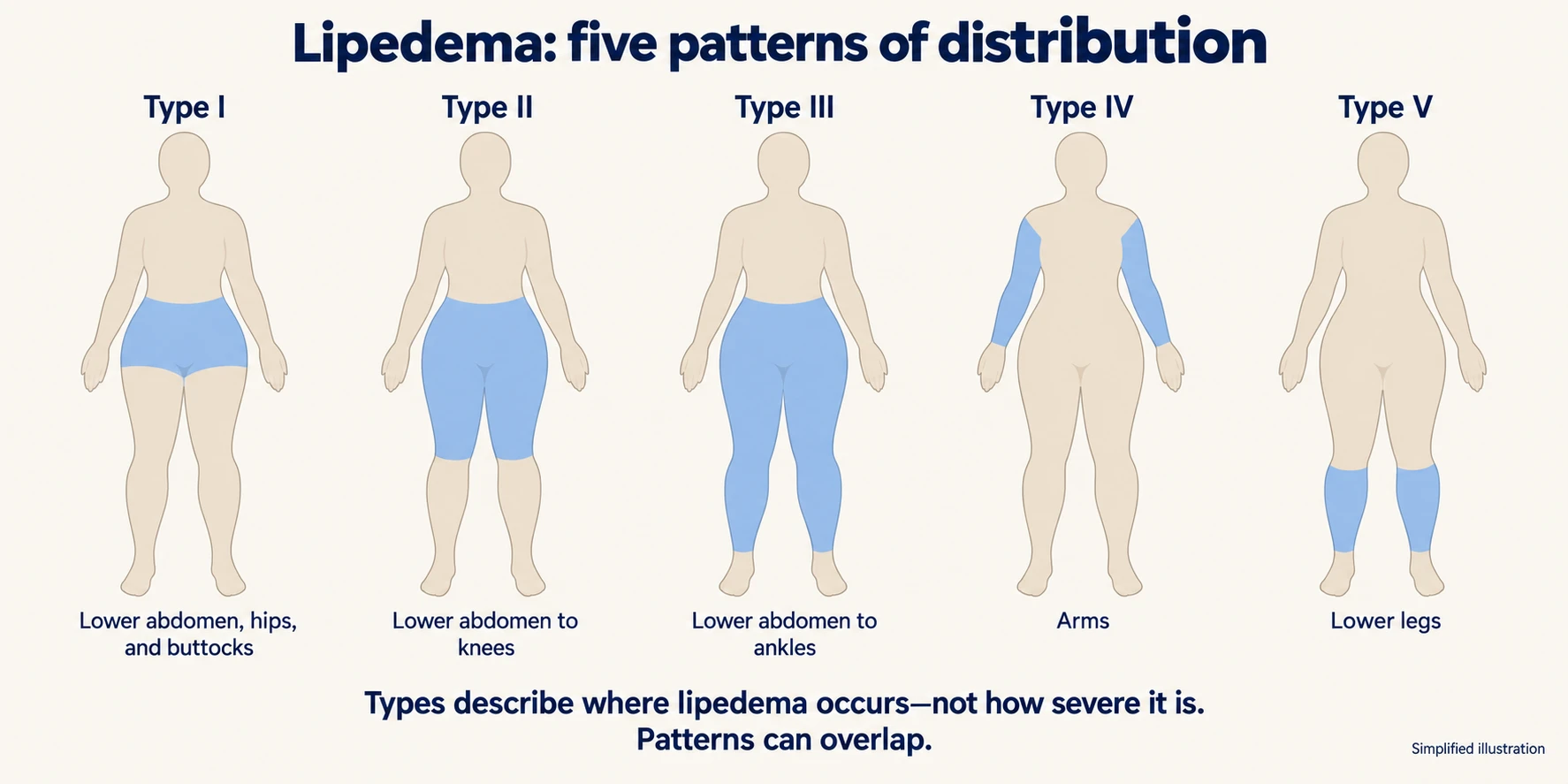
Types describe where lipedema occurs
One commonly used classification describes five patterns:
| Type | Areas affected |
|---|---|
| I | Lower abdomen, hips, and buttocks |
| II | Lower abdomen through the thighs to the knees |
| III | Lower abdomen through the legs to the ankles |
| IV | Arms |
| V | Lower legs |
These types describe the distribution of affected tissue, not the severity of symptoms.8
Stages based on tissue appearance do not reliably describe pain or disability, and progression is not inevitable.1,2
Getting an assessment
Diagnosis relies on a clinical history and examination. There is no single blood test or scan that confirms lipedema. Testing may help investigate other causes of symptoms.1,4
Useful information includes when changes began, the pattern of pain or bruising, effects on daily life, and treatments already tried. Ask what findings support the diagnosis and whether another condition is contributing.
Conservative care
Non-surgical care aims to ease symptoms and support function; it does not remove lipedema tissue. Options may include compression, tolerable physical activity, skin care, and help with pain or practical limitations.1,2
Nutrition and broader healthcare can address general health and related conditions. While no specific diet can cure lipedema or completely eliminate lipedema-specific fat tissue, evidence shows that lowering carbohydrate intake and fighting chronic systemic inflammation can significantly reduce pain, swelling, limb volume, and heaviness An anti-inflammatory, low-carbohydrate or ketogenic diet currently has the strongest backing for managing lipedema symptoms based on recent clinical reviews and studies. Emotional support may also be useful when pain, stigma, or body-image concerns affect daily life.
Manual lymphatic drainage is included for swelling or discomfort, particularly when another lymphatic condition coexists. It is not a stand-alone treatment for lipedema and does not remove lipedema fat.1,2
Surgery: benefits and limitations
The style of surgical procedure used to treat lipedema is known broadly as lymph-sparing liposuction. A 2026 German randomized trial found greater improvements in pain and quality of life at 12 months with liposuction plus ongoing care than with conservative care alone. Adverse events, including serious events, were more frequent in the surgery group.5
The participants had diagnosed lipedema, notable leg pain, and prior conservative treatment. Results from experienced German centres do not establish the best technique, long-term outcomes, or suitability for every patient or Canadian setting.5
A surgical consultation should cover alternatives, risks, recovery, continuing care, likely number of procedures, and total cost. Surgery is not a guaranteed cure.
see: Lipedema surgery: techniques and recovery
Choosing goals for care
Pain, mobility, sleep, work, and quality of life may matter more than changes in appearance. Agree on the outcomes you want to track and revisit the plan if its burden outweighs its benefit.6
Sudden one-sided swelling, warmth, redness, or tenderness requires prompt medical assessment rather than being attributed to lipedema. Call 911 for sudden shortness of breath, chest pain, coughing up blood, or fainting.7
References
- Kruppa P, et al. Lipedema World Alliance Delphi consensus-based position paper on the definition and management of lipedema. Nature Communications. 2026;17:427. https://doi.org/10.1038/s41467-025-68232-z ↩︎1 ↩︎2 ↩︎3 ↩︎4 ↩︎5 ↩︎6 ↩︎7
- Faerber G, et al. S2k guideline lipedema. Journal der Deutschen Dermatologischen Gesellschaft. 2024;22:1303–1315. DOI: 10.1111/ddg.15513. PubMed record ↩︎1 ↩︎2 ↩︎3 ↩︎4 ↩︎5
- NHS. Lipoedema. Page last reviewed July 25, 2023. https://www.nhs.uk/conditions/lipoedema/ ↩︎
- van la Parra RFD, Deconinck C, Krug B. Diagnostic imaging in lipedema: a systematic review. Obesity Reviews. 2024;25:e13648. https://pubmed.ncbi.nlm.nih.gov/37789512/ ↩︎
- Podda M, et al. Liposuction versus conservative therapy for patients with lipoedema in Germany: a multicentre, randomised controlled clinical trial. The Lancet. 2026;408:910–923. https://pubmed.ncbi.nlm.nih.gov/42692034/ ↩︎1 ↩︎2
- Günay UB, Talak GR, Demiröz A. Health-related quality of life among lipedema patients: a systematic review and meta-analysis. Phlebology. 2026;41(7):570–578. https://pubmed.ncbi.nlm.nih.gov/41436421/ ↩︎
- MyHealth.Alberta.ca. Deep vein thrombosis. Current as of July 31, 2024. https://myhealth.alberta.ca/health/Pages/conditions.aspx?hwid=aa68134 ↩︎
- Herbst KL, et al. Standard of care for lipedema in the United States. Phlebology. 2021. US consensus guideline ↩︎