

On this page
Areas that can be affected
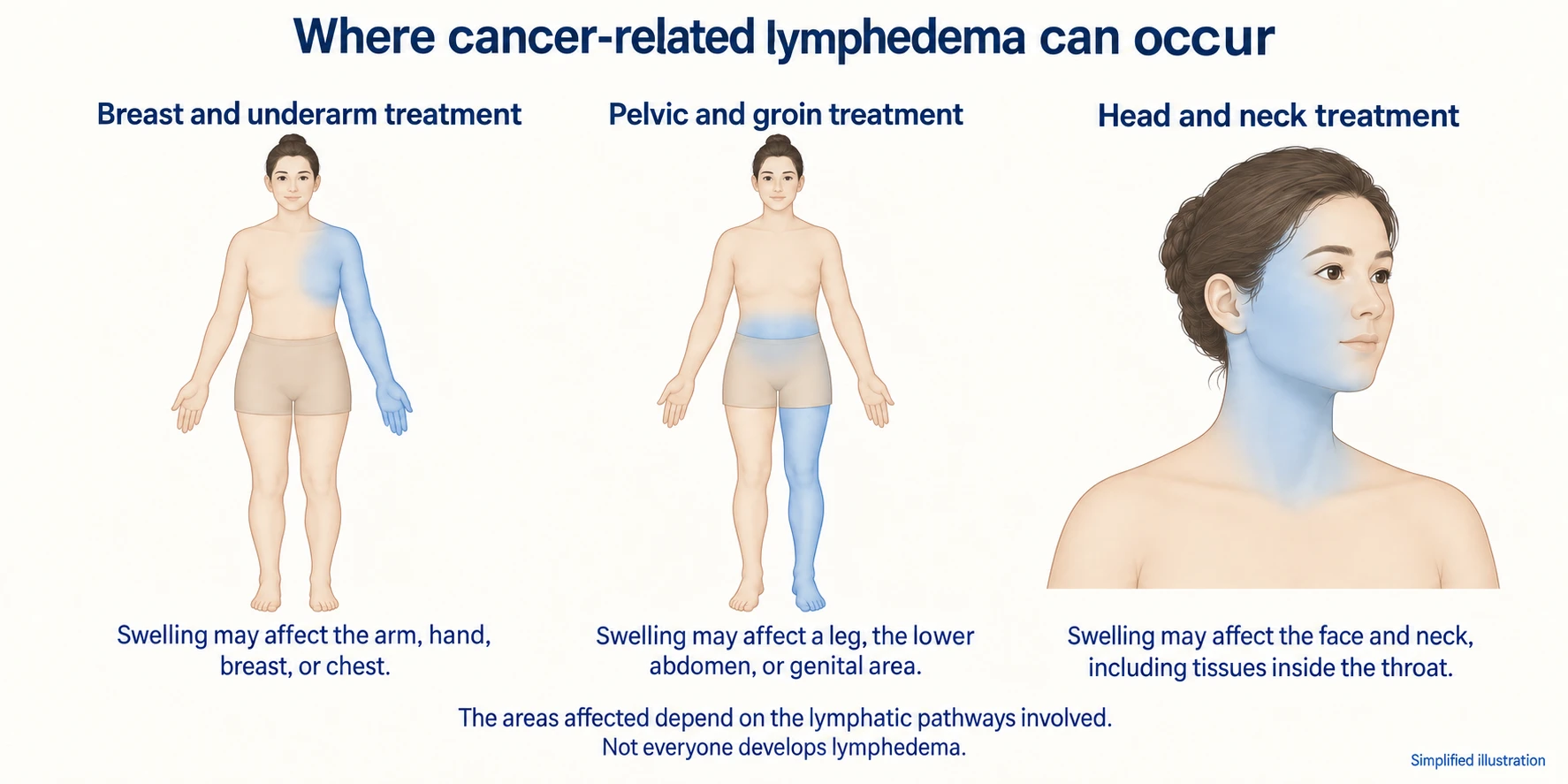
- Breast cancer treatment may affect the arm, hand, breast, or chest.
- Treatment involving pelvic or groin nodes may affect a leg, lower abdomen, or genital area.
- Head-and-neck treatment can cause external or internal swelling, sometimes affecting speech or swallowing. Breathing difficulty is an emergency.1,3,2
Being at risk is not a diagnosis. New swelling can also result from infection, a blood clot, medication, or cancer-related obstruction and should be assessed.1,4
Monitoring and early changes
Heaviness, tightness, altered clothing fit, and reduced movement may precede obvious swelling. Report persistent changes to your care team rather than waiting for a large size difference.1,2
Some cancer programs record measurements before treatment and repeat them afterward. After breast cancer treatment, regular checks can help detect early fluid buildup. One study found that using a device to measure these changes, followed by compression treatment when needed, reduced the risk of lasting swelling more than monitoring arm size with a tape measure.5
This supports monitoring in a defined setting, not one test or schedule for every cancer survivor. Ask which areas are at risk, whether a baseline is available, and whom to contact about changes.
Treatment and daily management
Care may combine compression, movement, skin care, self-management teaching, and manual lymphatic drainage. Selected patients may be considered for devices or specialist surgery.3,2
Exercise is not automatically unsafe after breast cancer treatment. Guidance supports individualized, supervised progression, accounting for healing and current treatment.6
Manual lymphatic drainage is not a guaranteed preventive treatment or cure. Evidence suggests limited additional excess-volume reduction when added to compression and exercise in breast-cancer-related lymphedema; findings for other body areas are less certain.7
Coordination with oncology
Your lymphatic practitioner needs to know about active treatment, recent procedures, infections, medication changes, and new restrictions. With consent, assessment findings can be shared with the relevant professionals.
Lymphatic care does not treat cancer or replace oncology follow-up. If advice conflicts, ask the clinicians involved to clarify the plan. Broad precaution lists are not always supported by strong evidence, so ask which restrictions apply to your circumstances.1,7
When to seek medical help
Seek prompt assessment for a hot, red, increasingly painful area, fever, chills, rapidly increasing swelling, or new one-sided swelling. Call 911 for sudden shortness of breath, chest pain, coughing up blood, or fainting.4,8
For non-urgent support, your oncology team, primary-care clinician, or cancer-rehabilitation service can help identify local options. Our Calgary and Alberta care directory lists local programs, providers, and contact details.
References
- National Cancer Institute. Lymphedema and Cancer. Updated March 6, 2024. https://www.cancer.gov/about-cancer/treatment/side-effects/lymphedema ↩︎1 ↩︎2 ↩︎3 ↩︎4 ↩︎5
- Cancer Care Alberta, Alberta Health Services. Understanding Cancer-Related Lymphedema. 2025. https://www.albertahealthservices.ca/assets/info/cca/if-cca-understanding-lymphedema.pdf ↩︎1 ↩︎2 ↩︎3 ↩︎4
- Canadian Cancer Society. Lymphedema. Accessed September 16, 2026. https://cancer.ca/en/treatments/side-effects/lymphedema ↩︎1 ↩︎2
- Cancer Care Alberta, Alberta Health Services. Lymphedema Pathway and Resource. Updated April 4, 2023. https://www.albertahealthservices.ca/assets/info/hp/cancer/if-hp-cancer-primary-care-lymphedema-pathway.pdf ↩︎1 ↩︎2
- Ridner SH, et al. A comparison of bioimpedance spectroscopy or tape measure triggered compression intervention in chronic breast cancer lymphedema prevention. Lymphatic Research and Biology. 2022;20(6):618–628. https://pubmed.ncbi.nlm.nih.gov/35099283/ ↩︎
- Davies C, Levenhagen K, Ryans K, Perdomo M, Gilchrist L. Interventions for breast cancer-related lymphedema: clinical practice guideline from the Academy of Oncologic Physical Therapy of APTA. Physical Therapy. 2020;100(7):1163–1179. https://pubmed.ncbi.nlm.nih.gov/32589208/ ↩︎
- International Society of Lymphology. The diagnosis and treatment of peripheral lymphedema: 2023 consensus document. Lymphology. 2023;56:133–151. Official PDF ↩︎1 ↩︎2
- MyHealth.Alberta.ca. Deep vein thrombosis. Current as of July 31, 2024. https://myhealth.alberta.ca/health/Pages/conditions.aspx?hwid=aa68134 ↩︎